
The Inside Scoop Episode
A poet and a science writer walk into a podcast and sometimes roast each other

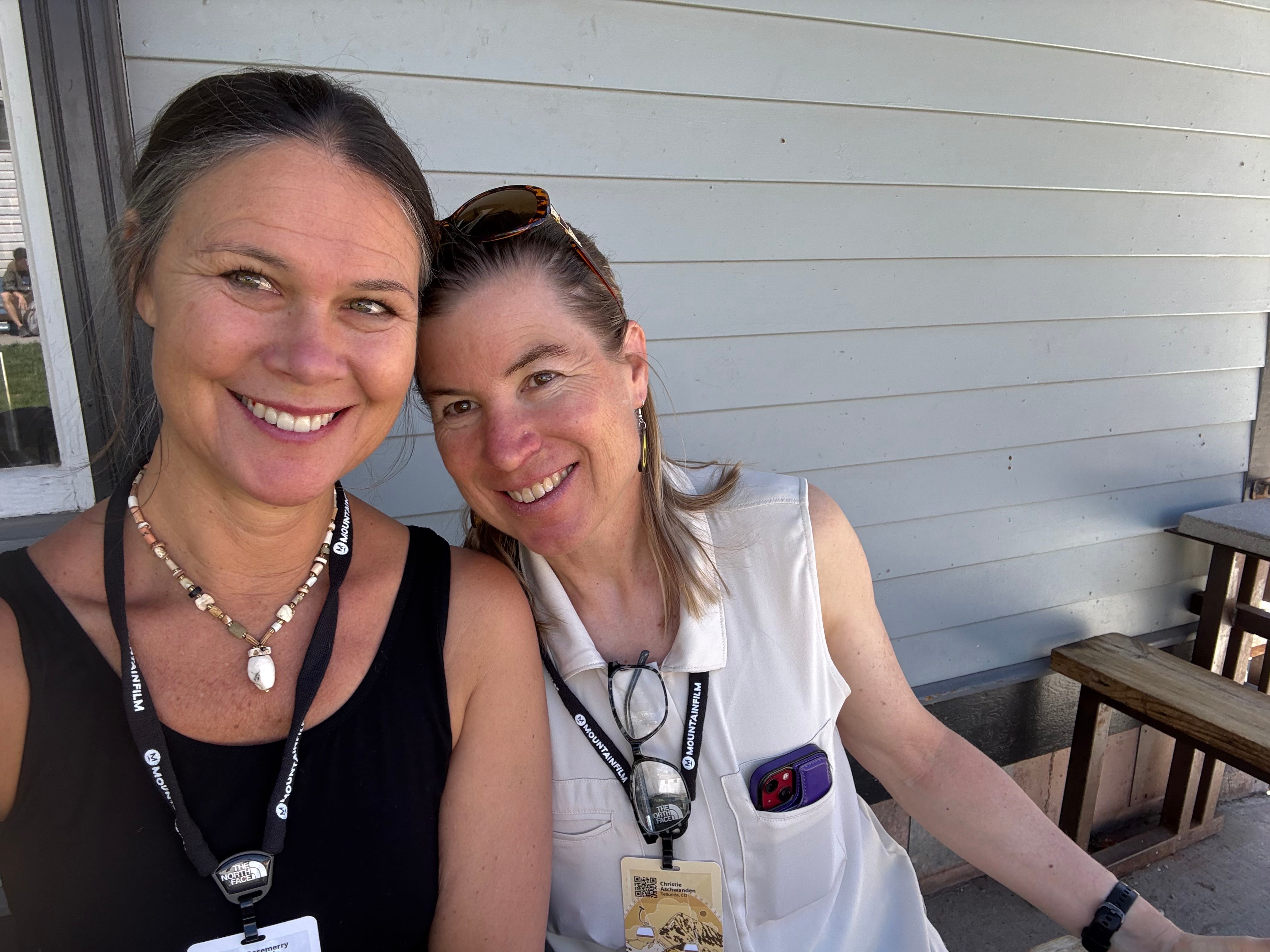
“The biggest change in my creative process is the willingness to let a poem not only reflect how messy life is, but let it stay messy, maybe even get messier.” —Rosemerry
“Yeah, I do want to have another bestseller. Yes, I do want people to read my stuff. I think it’s okay to admit that to ourselves and to the world and to want those things.”—Christie
Preview: Emerging Form Episode 164 with Rosemerry & Christie
What’s your creative super power? What creative ambitions do you still want to fulfill? How has your creative practice changed as you get older? What’s your most valuable tool for creative practice? These are the questions we often ask our guests, and in this episode, we ask them of each other … plus questions about the Emerging Form episodes that have stuck with us or changed our own practice, and a loaded “would you rather” question. It’s a raucous episode in which Christie and Rosemerry discover just how opposite and just how close they are … they call each other out, disagree, laugh, blush, tease and uplift each other.
Christie Aschwanden is the author of the New York Times bestseller, Good to Go, What the Athlete in All of Us Can Learn from the Strange Science of Recovery. She’s also host and producer of Uncertain, a podcast from Scientific American. She’s the former lead science writer at FiveThirtyEight and was previously a health columnist for The Washington Post. Her work has appeared in dozens of publications, including New York Times, Wired, Smithsonian, Slate, Popular Science, Discover, Science and Nature, and she’s received fellowships from the Santa Fe Institute, the Carter Center, and the Pulitzer Center for Crisis Reporting. She lives on a small farm in western Colorado.
Rosemerry Wahtola Trommer is a poet, teacher, speaker, and writing facilitator. Her daily audio series, The Poetic Path, is on the Ritual app. Her poems have appeared on A Prairie Home Companion, PBS NewsHour, O Magazine, Washington Post Book Club, and Carnegie Hall Stage. Her recent collections are All the Honey and The Unfolding. In 2024, she became Poet Laureate for Evermore, helping others explore grief and love through poetry. Since 2006, she’s written a poem a day, sharing them on her blog, A Hundred Falling Veils. Her one-word mantra is adjust.
What We’re Reading and Listening to:
Rosemerry:
Some books utterly exceed your expectations. That’s what happened when I read When the Ache Remains: Lessons on tending to the unfixable and finding beauty anyway. Because of the profound work Lisa Olivera has done to meet her own grief and depression, she offers gentle straight talk about how we, too, might tune into our own knowing—not to fix or to heal ourselves, but to turn toward our pain, integrate it, and live into the kind of ever-changing whole-hearted fullness in which our “wounds become wisdom-keepers.” It’s a nourishing book, a celebration of our individual and shared humanity.
I can barely believe it took me so long to watch Come Meet Me in the Good Light, the Oscar-nominated documentary about Colorado’s immediate past poet laureate Andrea Gibson and the ways in which the wildly popular performance poet met her cancer diagnosis and eventual death with her partner, also a popular poet, Megan Falley by her side. It’s intimate, generous, funny, heart breaking, heart opening. Such skillful weaving of poetry, real life struggle, deep love and meeting our mortality. The kind of film that makes you want to hug everyone you love and live more openly into every moment.
Christie:
I loved the Richard Powers’s Pulitzer Prize winning novel, The Overstory, about the lives of trees, and his latest novel, Playground, is a similar, yet different look at the ocean. The descriptions of the rich abundance of biological diversity in our oceans were mesmerizing. The story is also about friendship, how much people are willing to give up for their work, and most of all, AI. At its core, the book is a thought-provoking exploration of AI’s promises and dangers, and what we lose when we give ourselves over to this technology.
Where to begin with Naomi Klein’s fantastic book, Doppelgänger: A Trip into the Mirror World? It grew out of Klein’s experience of being confused for Naomi Wolf, a writer who first made her name as a feminist and author of The Beauty Myth. Somewhere along the way, Wolf went off the rails. During the covid pandemic, and she became a conspiracy theorist and regular guest on Steve Bannon’s podcast. Poor Klein was being so regularly conflated with the other Naomi that someone created an internet mnemonic to disambiguate them: “If the Naomi be Klein you’re doing just fine / If the Naomi be Wolf, oh, buddy. Ooooof.” If the book were just about this doppelgänger problem it wouldn’t be all that interesting, but instead, Klein uses her doppelgänger experience as a springboard to explore what the hell happened to public discourse during the pandemic. It’s one of the best things I’ve read about the ways that information became polarized and mis- and disinformation spread during and beyond covid. Klein looks at what she dubs the “mirror world” —an alternate universe of conspiracy theories and false histories about everything from covid to the January 6 insurrection. She coins a term, “pipiking” (a reference to Philip Roth’s Operation Shylock) to describes a specific form of bad-faith communication that has become ubiquitous, where nuanced, serious issues are trivialized and transformed into a farcical mirror of themselves as a way of dismissing them. Throughout the book, her critiques are sharp and deeply researched. Highly recommend.
Christie Sends Me a Photo
Her head is pasted onto my body
wearing a very plain black dress.
My head’s pasted onto her body
wearing a flamboyant jumpsuit
with pixilated technicolor chaos,
a jumpsuit she’s tried to get me
to wear for months.
She knows wearing patterns
makes me queasy. And what
is it in us that loves to make
our beloveds squirm?
I’m an easy target.
She knows I will squeal and
splutter and rail, so when I call
in a righteous outrage
over how she’s dressed my likeness
in a blenderized rainbow,
she laughs and I laugh
and something is so right
with the world then—
this goofy, giddy moment
when the stakes are low
and I am uncomfortable and prickly
and feel so deeply seen,
so able to laugh at the lines I draw.
I fall inside the laughter,
feel it wrap around me
bright as that flashy jumpsuit.
And I, who crave what is solid,
I dissolve into that brightness.
—Rosemerry Wahtola Trommer
A Note About Paid Subscriptions:
First, we want to thank ALL our subscribers! We are so grateful you join us in this conversation about what it is to engage with yourself, the world and others in a creative way. And a BIG thank you to our paid subscribers. You make this podcast possible. Only our paid subscribers receive our bonus episodes as a thank you for their financial support. This week, Christie and Rosemerry continue our interview and touch on creative mistakes we’ve made that we’ve learned from (um, or not) (Christie REALLY roasts Rosemerry). We also talk about longing for approval, taking on too much, and how where we live has affected our creative practice. We also each name our three dream guests … let’s hope to hear them on Emerging Form soon!
Two Questions:
(share your answers with us here on Substack or in our FB group)
How does where you live affect your creative practice?
How has your creative practice changed as you get older?
Emerging Form is a reader-supported publication. To receive new posts and support my work, consider becoming a free or paid subscriber.
Hello to you both and thanks for this post. I enjoyed hearing what you’re up to, musing about and reading. About creativity…I live in Colorado, surrounded beloved mountains, forests and rivers. The solitary time I spend among them invites me into a deep, reverent quiet that is my greatest source of creativity. I’m not sure I’d know how to orient myself in the world, or how to inspired, if I couldn’t step out my door and sit quietly with the forest when I need to. And yes, my creativity has changed radically in the past few years. And I mean that literally! It has somehow tapped into a deeper, stronger root. Or maybe into a deeper root system. I’m 54 and am emerging from a six-year long health ordeal while also going through all the changes that being in the fifties entails. The creativity that is emerging out of all that is WILD. Wild and primal and free in a way I couldn’t have imagined earlier in life. Why doesn’t anyone tell us how awesome it can be?? Thanks for the questions😊